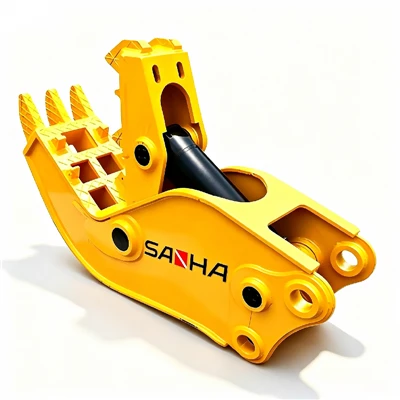
Hauling mixed demolition rubble to a landfill is a one-way expense. You pay for every ton of concrete, every ton of steel, and every mile of transport. But if you process that rubble on-site with a hydraulic pulverizer, you separate the concrete from the rebar. The steel goes to a scrap yard-often worth $150 to $300 per truckload. The crushed concrete becomes reusable aggregate. Suddenly your debris is a revenue stream.
Here's how it works, why it beats a breaker, and what to look for when buying.
Pulverizer vs. Hydraulic Breaker: Different Tools, Different Jobs
A hydraulic breaker is a primary demolition tool. It smashes walls, foundations, and structures into manageable rubble. It's loud, violent, and creates vibration.
A pulverizer is a secondary processing tool. It picks up concrete chunks-still embedded with rebar-and crushes them further while separating the steel. The jaws close slowly with immense force. Concrete crumbles; rebar bends, snaps, or gets cut by built-in blades. You get two clean streams: recyclable concrete and recyclable steel.
Use the breaker to bring the building down. Use the pulverizer to turn the rubble into cash.
How a Pulverizer Separates Concrete and Rebar
The jaws do the work. One fixed jaw, one moving jaw. Both lined with hardened teeth and often replaceable cutting blades.
When the jaws close on a concrete block, the teeth concentrate force and crack the concrete. As the jaws close further, the concrete crushes into smaller pieces and falls through the gap. The rebar doesn't crumble-it bends. Cutting blades near the back of the jaw shear the steel cleanly. The rebar either falls away or stays loose enough to pull out later.
Many modern pulverizers rotate 360°, letting the operator position the jaws precisely without moving the excavator. That means less wasted motion and faster processing.
Four Ways a Pulverizer Saves You Money
1. Reduced transportation volume.** Crushed concrete packs tighter than mixed rubble. You fit more tons per truckload-often cutting truck trips by 30–50%.
2. Rebar recycling income.** Clean steel scrap has value. A project yielding 20 tons of rebar can put $3,000 or more back in your pocket. Mixed rubble gets charged as waste; separated steel gets paid.
3. Reduced manual labor.** No workers with torches or grinders cutting rebar out of concrete. The pulverizer does it from the safety of the cab. One operator processes tons per hour.
4. On-site reuse of crushed concrete.** Use it as backfill, road base, or temporary haul roads. You save on disposal and on buying virgin aggregate.
A mid-sized project with 500 tons of rubble can cut net disposal costs from $35,000 to around $2,000-plus recover scrap value.
Key Parameters When Choosing a Pulverizer
- **Jaw opening:** Determines the maximum block size you can bite. Doocang offers 420 mm to 1100 mm.
- **Crushing force:** Measured in kN. Higher force handles harder concrete and thicker slabs. Doocang ranges from 170 kN to 1350 kN.
- **Rotation:** A 360° rotating pulverizer saves time in tight spaces and against walls.
- **Replaceable teeth and blades:** You replace only what's worn, not the whole jaw. Keeps long-term cost low.
- **Carrier compatibility:** Match the pulverizer to your excavator. Doocang units fit 13–30 ton machines.
Grease pivot points daily. Check teeth and blades. Fix hydraulic leaks early. A maintained pulverizer lasts thousands of hours.
Conclusion: Stop Paying to Throw Away Money
Demolition rubble is concrete and steel-both have value if you process them correctly. A hydraulic pulverizer unlocks that value. It separates rebar, reduces volume, eliminates manual labor, and creates reusable aggregate.
Doocang pulverizers are built for 13–30 ton excavators, with multiple jaw openings and crushing forces. Teeth and blades are replaceable. Optional 360° rotation lets you work where other tools can't.
Want to estimate your savings? Send us your material type and average daily demolition volume. We'll recommend the right model and calculate the payback.