Earth Auger for Excavators: How a $4,000 Attachment Drills 200 Holes a Day
In early 2025 we shipped six hydraulic earth augers to a solar farm contractor outside Al Ain, in the Emirate of Abu Dhabi. The job was simple on paper: drill 14,000 pile holes across a 3-square-kilometre site, 300 mm diameter, 1.8 metres deep, in sandy soil with a bit of caliche.
The contractor had planned to use hand-held post-hole diggers. He'd priced it at 40 crews, two holes per crew per hour, 10-hour days. That's 800 holes a day - and 17 working days just to drill the holes, before a single solar panel went up.
He called us on a Tuesday. By the following Monday, six augers were on six 8-ton excavators.
Each machine drilled 200 holes a day. The whole 14,000-hole site was done in 12 days.
That's the argument for an earth auger, in one solar farm in the desert.
What is an earth auger, in plain words?
An earth auger is a hydraulic drill on the end of your excavator arm. It has three parts:
A hydraulic drive motor - spins the shaft, rated in Newton-metres of torque
A hexagonal or round drive shaft - transfers the spin down
A flighted auger flight - the spiral blade that carries dirt out of the hole as it drills
Point it at the ground, apply down pressure from the excavator arm, and the spiral flight pulls itself into the soil, lifting cuttings out as it goes. Pull it out, the hole is done.
It is not a pile driver. It does not hammer. It is not a drilling rig for rock. It is for soil, sand, loam, clay and light caliche - the ground that 90% of fence, utility and solar work happens in.
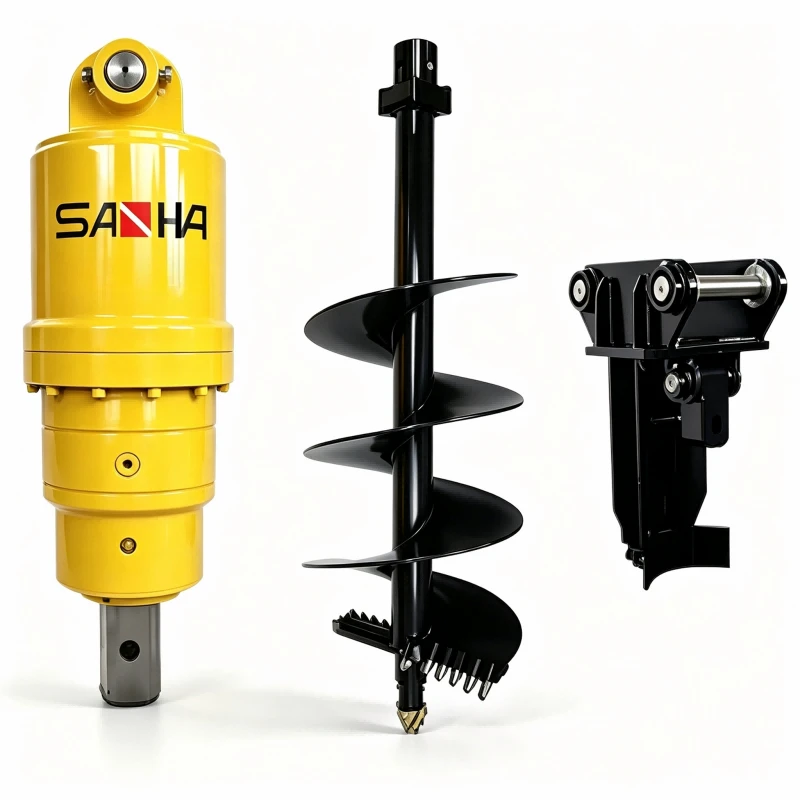
Earth auger vs hand digging vs pile driver
This is the comparison every contractor runs before buying:
|
Task |
Hand post-hole digger |
Excavator earth auger |
Pile driver / hammer |
|
Holes per day (one crew) |
15–25 |
150–250 |
N/A (drives piles, doesn't drill) |
|
Hole diameter |
150–300 mm |
150–900 mm |
N/A |
|
Depth per hole |
1 m |
1.5–6 m (extension available) |
N/A |
|
Labour per hole |
2 men, 20 min |
1 operator, 2 min |
1 operator, 1 min |
|
Best for |
Tiny jobs, hard-to-reach spots |
Fence rows, solar farms, utility poles |
Driving steel H-piles into drilled holes |
The key thing to understand: an auger drills the hole. A pile driver hammers the pile into the hole. On a solar farm, you often need both - auger first, then pile driver. But if you're only drilling fence posts or tree planting holes, the auger alone is the whole job.
The Al Ain solar farm numbers
Let's put real numbers on the Abu Dhabi job, because solar is where augers are earning the most money right now:
Site: 3 km², flat desert, sandy soil with 20% caliche
Hole spec: 300 mm diameter × 1.8 m deep
Equipment: 6 × 8-ton excavators, each with a 3,000 Nm auger drive and a 300 mm flight
Crew per machine: 1 operator + 1 spotter
Output: 200 holes per machine per day
Total: 14,000 holes in 12 days
The contractor told us the hand-digging plan would have taken 17 days and 40 workers. The auger plan took 12 days and 12 people.
His line: "I was going to hire 40 Bedouin crews for three weeks. Instead I hired 12 operators for 12 days. The augers paid for themselves in the first four days."
The two numbers that decide which auger to buy
When contractors ask us "which auger do I need?", they usually start with diameter. They should start with two other numbers.
1. Torque (Nm)
Torque is what gets the auger through hard soil. Too little torque and the flight stalls in clay. Too much and you're paying for capacity you'll never use.
|
Soil type |
Required torque |
|
Soft sand, loam |
1,500–2,500 Nm |
|
Clay, compacted soil |
2,500–4,000 Nm |
|
Caliche, light rock, frozen ground |
4,000–8,000 Nm |
|
Solid rock |
Don't use an auger - use a drilling rig |
2. Hydraulic flow (L/min)
The auger motor needs a specific flow to spin at the right speed. Too little flow and it crawls. Too much flow and it over-speeds, which chews up the gearbox.
Match the auger's rated flow to your excavator's auxiliary circuit. This is the #1 mistake buyers make - they buy the biggest auger they can afford, then find their 6-ton digger only puts out 40 L/min and the auger can't turn.
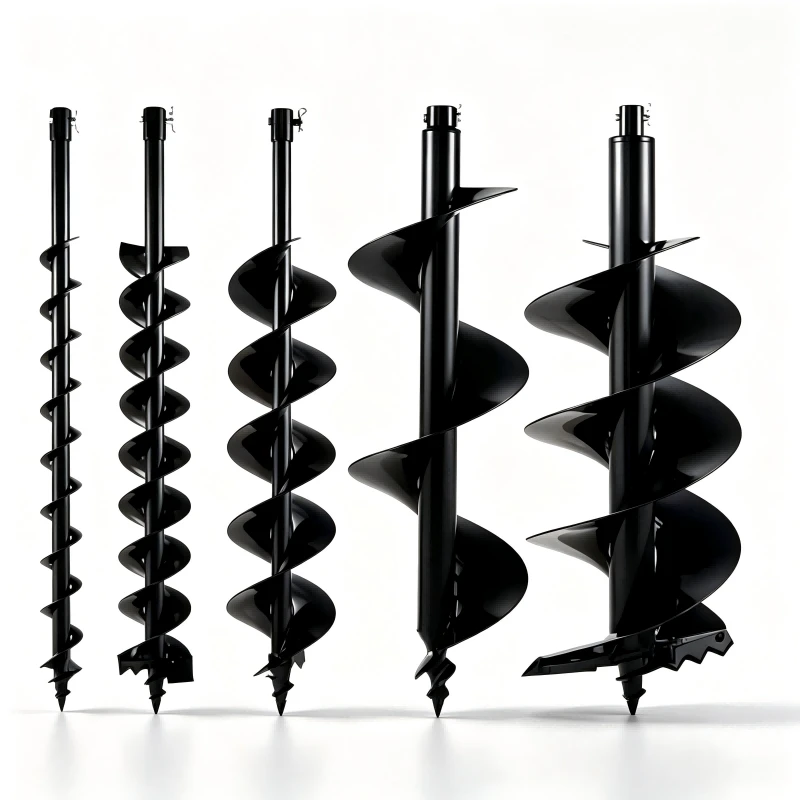
Auger sizes we ship
|
Excavator tonnage |
Auger drive torque |
Typical flight diameter |
Hole depth |
FOB price |
|
1.5–3 ton mini |
800–1,500 Nm |
100–200 mm |
1.2 m |
\(1,200–\)1,800 |
|
4–6 ton |
1,500–2,500 Nm |
200–350 mm |
1.5 m |
\(2,000–\)2,800 |
|
7–10 ton |
2,500–4,000 Nm |
300–500 mm |
2.0 m |
\(3,200–\)4,500 |
|
12–18 ton |
4,000–6,000 Nm |
400–800 mm |
3.0 m |
\(5,500–\)8,000 |
|
20–30 ton |
6,000–12,000 Nm |
600–1,000 mm |
4.0 m+ |
\(9,000–\)15,000 |
Extension shafts are available for deeper holes - 1 m, 1.5 m and 2 m extensions bolt on between the drive and the flight.
The three mistakes that kill augers early
We see these on every warranty claim:
1. Drilling into rock without knowing it's there
An auger flight is a steel spiral, not a rock drill. If you hit a boulder, the flight stalls, the gearbox whines, and you've just stripped the planetary gears. Always scan the site first - a metal detector or a quick test hole saves a $3,000 gearbox.
2. Forcing the down pressure
Operators think more down pressure = faster drilling. Wrong. The flight pulls itself in. If you push too hard, the flight binds in the hole and the motor stalls. Let the auger walk itself down.
3. Forgetting to grease the gearbox
The auger drive has a gearbox that needs one pump of grease every 40 hours. Skip it and the gears run dry. We've seen gearboxes destroyed in 200 hours because nobody found the grease nipple.
Who should buy an earth auger?
Buy it if:
You're drilling fence rows, utility poles, tree planting holes or solar pile holes
You're paying hand crews to dig post holes
You have an excavator with at least one auxiliary hydraulic circuit
Don't buy it if:
You're drilling solid rock. You need a drilling rig with a rock auger or a DTH hammer.
You're driving piles. You need a pile driver, not an auger.
You only drill 10 holes a year. Rent one.
H2: Bottom line
An earth auger is one of the highest-ROI attachments you can bolt onto an excavator. On a solar farm, a fence row or a utility pole job, it turns a two-man, twenty-minute hole into a one-operator, two-minute hole.
The trick is matching the torque and flow to your soil and your excavator. Get that right and the auger will drill 20,000 holes before it needs a rebuild.
Send us your excavator model, the soil type on your site, and the hole diameter and depth you need. We'll match the right auger drive and flight, and quote landed to your port.
FAQ
Q: What size excavator do I need for an earth auger?
A: Any excavator from 1.5 tons up. Mini diggers with small augers do fence posts; 8–10 ton machines with 3,000 Nm drives are the sweet spot for solar and utility work.
Q: How deep can an excavator auger drill?
A: Standard flights drill 1.5–2 m. With extension shafts, you can reach 4–6 metres depending on the excavator's reach.
Q: Can an auger drill through rock?
A: Light caliche and weathered rock, yes, with a rock flight and high torque. Solid bedrock needs a dedicated drilling rig with DTH hammers.
Q: How much does an excavator earth auger cost?
A: \(1,200 for a mini-excavator unit, up to \)15,000 for a 30-ton-class high-torque drive. The flight diameter you choose adds to the price.