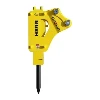
With the construction machinery industry continuously developing toward higher efficiency and reliability, hydraulic breakers are becoming increasingly important in construction, mining, road development, and foundation engineering applications. As essential parts of hydraulic breakers, the structural design of components directly affects equipment performance, service life, and operational safety. Through optimized structural layouts, high-strength materials, and precision manufacturing processes, hydraulic breaker components are able to perform reliably in complex and demanding working environments.
Hydraulic breaker components feature modular structures, high impact resistance, precision manufacturing, and convenient maintenance. Different functional parts work together to achieve power transmission, impact generation, and equipment protection. The main structural components include chisel assemblies, piston assemblies, cylinder assemblies, control valve assemblies, nitrogen chamber assemblies, sealing systems, and connection components.
The chisel assembly is the key working component that directly performs breaking operations. Its structural design focuses on high strength and wear resistance. Since the chisel is exposed to continuous high-speed impacts and reaction forces from materials, it is usually manufactured from specialized alloy materials and strengthened through heat treatment processes. Proper structural dimensions ensure efficient impact energy transfer and reduce energy loss during operation.
The piston assembly is the core structure responsible for power conversion inside the hydraulic breaker. It features high machining accuracy and excellent movement stability. Since the piston moves rapidly back and forth inside the cylinder, its surface precision and wear resistance are extremely important. Optimized piston structures help reduce friction, improve impact efficiency, and maintain stable long-term operation.
The cylinder assembly serves as the main load-bearing structure of the hydraulic breaker. It must withstand internal pressure, impact vibration, and external working loads. Therefore, cylinders are usually manufactured from high-strength steel and processed with precision machining techniques to improve rigidity and resistance to deformation. Proper internal structural design also helps reduce component wear and extend service life.
The sealing system is another important part of the hydraulic breaker structure. Since equipment often operates in harsh environments, the internal hydraulic system remains under high pressure for extended periods. Sealing components must provide excellent wear resistance, temperature resistance, and aging resistance. A well-designed sealing system prevents hydraulic oil leakage and protects internal components from contamination.
In addition, control valves, nitrogen chambers, and connection components play important roles in the overall structure. Control valves regulate hydraulic oil circulation to achieve continuous impact operation, nitrogen chambers improve impact performance through energy storage, and bolts and pins ensure secure connections between structural components.
With continuous advances in manufacturing technology, hydraulic breaker component structures are developing toward lightweight design, higher strength, and intelligent performance. Through digital design, advanced material applications, and precision manufacturing technologies, modern components continue to achieve improvements in performance and reliability. In the future, advanced structural designs will further promote hydraulic breaker development and provide more stable and efficient equipment solutions for the construction machinery industry.