Lotus Grapple: The Multi-Tine Grab That Picks Up What a Bucket Drops
In a scrap yard in Izmir, Turkey, an excavator with a bucket was trying to pick up tangled rebar and crushed car bodies. Half slid off the lip every swing. The owner measured it: 40 minutes a shift lost just re-grabbing what the bucket dropped.
Two weeks after fitting a five-tine lotus grapple, the same machine was loading straight into the furnace feed without chasing scrap across the yard.
That's the whole argument.
What it is, in plain words
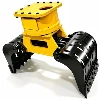
A lotus grapple - also called orange peel grapple, cactus grapple or multi-tine grab - is a set of curved steel tines that open and close like flower petals on your excavator arm.
Tine count decides the job. More tines trap finer material; fewer tines lift bigger single items.
Most units rotate 360°, so you twist a bundle into position without moving the machine.
It doesn't crush, doesn't cut. It grabs and holds - scrap, waste, logs, stone, rubble. A bucket scoops; a grapple holds.
Lotus grapple vs bucket vs 2-jaw grab
|
Factor |
Bucket |
2-jaw grapple |
Lotus grapple |
|
Holds loose / tangled material |
Poor - slides off |
Well |
Best |
|
Picks one heavy item |
No |
Yes |
Depends on tines |
|
Sorting / scavenging |
No |
Limited |
Yes |
|
Typical use |
Dig, load |
Demolition cleanup |
Scrap, waste, bulk |
|
Price |
Low |
Mid |
Mid to high |
Handling one shape of material? A 2-jaw grab is enough. Handling mixed, loose, irregular scrap? Multi-tine, because the tines trap small pieces instead of dropping them.
The Izmir scrap yard numbers
14-ton excavator, ferrous scrap. Before: ~40 min shift lost re-grabbing, 12 t/hour loading, 2 men hand-sorting.
After a 5-tine rotating lotus grapple: re-grab losses near zero, 18-20 t/hour loading, one man sorting non-ferrous only.
"The bucket was a shovel. This thing is a hand."
Buy one if - don't buy one if
Buy: scrap yards, waste transfer stations, port bulk handling, stone yards, log handling.
Don't buy: trenching or grading (bucket); breaking concrete (breaker); moving neat uniform material (cheaper 2-jaw grab).
Three mistakes that wear them out
Too few tines for the material - a 3-tine grab on shredded scrap drops half of it.
Dry pins - grease the tine pivots every shift or bushings go in 500 hours.
Swinging with the grab wide open - an open grab is a wide unbalanced load; it kills the rotator and the dipper.
Sizing table
|
Excavator |
Tines |
Weight |
Max opening |
FOB (approx) |
|
6-10 t |
3-4 |
400-600 kg |
900-1,200 mm |
\(2,800-\)4,000 |
|
12-18 t |
4-5 |
800-1,100 kg |
1,300-1,600 mm |
\(5,000-\)7,000 |
|
20-30 t |
5-6 |
1,400-2,000 kg |
1,700-2,200 mm |
\(8,500-\)12,000 |
|
30-45 t |
6-10 |
2,500-4,000 kg |
2,300-2,800 mm |
\(15,000-\)22,000 |
Two auxiliary circuits needed: tine open/close + rotation.
H2: Bottom line
If you're losing material off a bucket lip every shift, a lotus grapple pays for itself on the first truck you load.
Send a photo of your material and your excavator model - we'll tell you the right tine count, and if a cheaper 2-jaw grab would do, we'll say so.
FAQ
Q: What is a lotus grapple?
A multi-tine excavator grab (orange peel / cactus grapple) that opens and closes like petals to hold loose bulk material.
Q: How many tines?
Fewer for large single items, more for fine or mixed material. Scrap yards run 4-5.
Q: Can it dig?
No- it holds and places. Digging needs a bucket.
Q: Shipping?
Weekly from Qingdao worldwide. Send your excavator model for a landed quote.
Q: Can it dig? No
- it holds and places. Digging needs a bucket.
Q: Shipping?
Weekly from Qingdao worldwide. Send your excavator model for a landed quote.