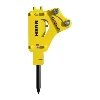
With the construction machinery industry continuously moving toward higher efficiency and intelligent solutions, hydraulic breakers are being increasingly used in construction, mining, road development, and infrastructure projects. As essential parts of hydraulic breaker systems, component design concepts directly influence equipment efficiency, operational stability, and service life. Modern hydraulic breaker component design focuses not only on structural strength and performance but also on energy efficiency, safety, and long-term reliability.
The design of hydraulic breaker components first emphasizes the combination of high strength and durability. Since breakers operate under continuous impact, high pressure, and strong vibration conditions, key parts such as chisels, pistons, and cylinders must have excellent impact resistance. During the design process, manufacturers typically use high-strength alloy materials combined with advanced manufacturing technologies to improve component load capacity and ensure reliable performance in demanding working environments.
Structural optimization is one of the most important design principles for hydraulic breaker components. By analyzing stress distribution and impact forces, engineers can optimize component structures to achieve more balanced energy transmission. For example, chisel designs must balance impact efficiency and wear resistance to prevent excessive damage caused by uneven loading. Piston structures must maintain stability during high-speed movement while improving energy conversion efficiency. Proper structural optimization enhances equipment performance and reduces the possibility of failures.
Lightweight design is also an important trend in modern hydraulic breaker component development. While maintaining strength and safety, optimized material selection and improved structural designs can reduce component weight, decrease operating loads, and improve overall efficiency. Lightweight designs also make equipment maintenance easier and help reduce energy consumption.
Precision manufacturing is another important concept integrated into hydraulic breaker component design. Since multiple internal parts must work together with accurate coordination, designers need to consider machining precision and assembly requirements from the beginning. High-precision components reduce operating gaps, minimize friction losses, and allow equipment to operate more smoothly.
Safety and maintenance convenience are also key considerations in component design. Modern design approaches focus on improving operational safety by optimizing structural layouts and strengthening critical areas. At the same time, modular design concepts are increasingly applied to component manufacturing, making replacement and maintenance more convenient and improving repair efficiency.
In addition, environmental considerations are gradually becoming part of hydraulic breaker component design. By improving component durability, reducing energy losses, and lowering maintenance frequency, manufacturers can reduce long-term operating costs and support more sustainable construction practices.
With the continuous development of advanced materials, digital design methods, and intelligent manufacturing technologies, hydraulic breaker component design concepts are constantly evolving. In the future, components featuring high performance, excellent reliability, lower energy consumption, and intelligent capabilities will further advance hydraulic breaker technology and provide more stable and efficient solutions for the construction machinery industry.