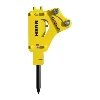
With the continuous development of the construction machinery industry, hydraulic breakers are being increasingly used in building demolition, road construction, mining, and foundation engineering. As important parts of hydraulic breakers, different components vary not only in material performance and manufacturing processes but also in their shapes and structural designs. Proper component shapes improve energy transfer efficiency, enhance wear resistance, and help equipment adapt to different working environments.
Hydraulic breaker components come in various designs, and each part has a specific shape based on its function. The chisel is one of the most representative working components, and its shape is optimized according to breaking materials and construction requirements. Common chisel designs include pointed chisels, flat chisels, and wedge chisels. Pointed chisels have a sharp tip that concentrates impact force and are suitable for rock breaking and hard material processing. Flat chisels feature a wider working surface and are commonly used for concrete demolition and trenching operations. Wedge chisels provide strong splitting capability and are suitable for applications requiring material separation.
The piston is an important internal moving component of a hydraulic breaker and usually features a cylindrical design. This shape allows the piston to move smoothly back and forth inside the cylinder, reducing friction resistance and improving energy conversion efficiency. The piston surface is precisely machined to achieve better contact with the cylinder and ensure stable long-term operation.
The cylinder is one of the main structural components of a hydraulic breaker and generally has a tubular design with a precisely machined internal space. This structure allows the cylinder to withstand hydraulic pressure and impact vibration while providing stable guidance for piston movement. A well-designed cylinder structure improves equipment strength and reduces wear on internal components.
Protective components such as inner and outer bushings usually adopt ring-shaped structures. These designs support chisel movement and reduce friction between components. The circular structure helps distribute stress evenly, improving durability and extending maintenance intervals.
Sealing components are designed in different shapes according to their installation positions and functional requirements. Common designs include circular sealing rings, dust seals, and combined sealing structures. These specialized shapes provide effective contact with internal equipment surfaces, prevent hydraulic oil leakage, and block external contaminants.
In addition, control valves, bolts, and pins also feature unique structural designs. Control valves usually adopt precision valve body structures to regulate hydraulic oil flow, while bolts and pins use cylindrical designs to connect and secure different components.
With continuous improvements in manufacturing technology, hydraulic breaker component designs are developing toward greater efficiency, lighter structures, and enhanced performance. Through computer-aided design, precision manufacturing, and material optimization, modern components can better adapt to complex construction conditions. In the future, advanced structural designs will continue to improve hydraulic breaker performance and provide more reliable and efficient solutions for the construction machinery industry.