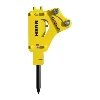
With the rapid development of the construction machinery industry toward intelligent and efficient solutions, hydraulic breakers have become essential excavator attachments widely used in building demolition, mining, road construction, and infrastructure projects. As core elements of hydraulic breaker systems, advanced component technologies directly influence breaking efficiency, operational stability, and service life. In recent years, continuous improvements in material science, manufacturing processes, and intelligent inspection technologies have driven significant progress in hydraulic breaker component development.
Technologies related to hydraulic breaker components mainly include material application, precision manufacturing, heat treatment, structural optimization, and intelligent inspection. Among these technologies, material development is a fundamental factor in improving component performance. Since hydraulic breakers operate under high-impact and heavy-load conditions, key parts such as chisels, pistons, and cylinders require excellent strength, toughness, and wear resistance. High-strength alloy steels and specialized wear-resistant materials are now widely used in component manufacturing, effectively improving impact resistance and service life.
Precision manufacturing technology is an important factor in ensuring hydraulic breaker component quality. Modern processing methods use CNC machines, automated production equipment, and high-accuracy machining technologies to improve dimensional precision and assembly stability. Precision manufacturing reduces operational errors between components, minimizes friction losses, and improves energy transmission efficiency, allowing hydraulic breakers to maintain more stable performance during operation.
Heat treatment technology is another critical process in hydraulic breaker component production. Through optimized quenching, tempering, and surface strengthening treatments, the internal structure of metal materials can be improved, increasing hardness and fatigue resistance. For example, properly treated chisels can withstand higher impact frequencies and reduce wear, while specially processed pistons achieve better movement stability and extended service life.
Structural optimization technology focuses on improving component design. Through computer-aided design and engineering simulation analysis, manufacturers can optimize component structures and achieve more balanced stress distribution during impact operations. Optimized designs not only improve equipment performance but also reduce the risk of failures and enhance overall reliability.
In addition, intelligent inspection technology is gradually being introduced into hydraulic breaker component manufacturing. Through automated inspection equipment and digital management systems, manufacturers can accurately evaluate component dimensions, hardness, and performance indicators to ensure products meet quality standards. Intelligent inspection improves production efficiency and enhances product consistency.
With increasing demands for environmental efficiency and higher construction productivity, hydraulic breaker component technologies will continue to develop toward higher performance, lower energy loss, and intelligent operation. Through advanced materials, innovative manufacturing processes, and digital technology integration, hydraulic breaker components will further improve equipment capabilities and provide more reliable and efficient technical support for the construction machinery industry.