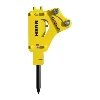
With the continuous development of the construction machinery industry toward higher efficiency and reliability, hydraulic breakers are becoming increasingly important in construction, mining, road development, and infrastructure projects. As essential parts that ensure stable hydraulic breaker operation, the manufacturing process of components directly affects product quality, service life, and equipment efficiency. Through advanced manufacturing technologies and strict quality control, modern hydraulic breaker components continue to achieve better performance and provide more reliable support for the construction machinery industry.
The manufacturing process of hydraulic breaker components generally includes material selection, forging, heat treatment, machining, surface treatment, and quality inspection. Each production stage plays an important role in determining final product performance. Core components such as chisels, pistons, and cylinders require strict manufacturing procedures to withstand high-intensity and high-frequency impact conditions.
Material selection is the foundation of hydraulic breaker component manufacturing. Since equipment operates under heavy impact forces and continuous vibration, manufacturers usually select high-strength alloy steel as the primary material. High-quality steel provides excellent toughness, fatigue resistance, and wear resistance, helping components maintain stable performance in complex working environments.
Forging is an important process for improving structural strength. Through high-temperature forming, the internal structure of metal materials can be improved, increasing density and enhancing impact resistance. For example, hydraulic breaker chisels often undergo multiple forging processes to create a more uniform internal structure, which improves overall strength and extends service life.
Heat treatment is another critical stage in hydraulic breaker component production. Processes such as quenching and tempering adjust material hardness and toughness, allowing components to maintain high strength while improving resistance to deformation. Proper heat treatment enhances chisel wear resistance, improves piston impact performance, and increases cylinder durability.
Machining processes are mainly used to ensure component accuracy and assembly performance. Modern manufacturing often uses CNC machining equipment to achieve precise processing of individual parts, ensuring proper coordination between components. High-precision machining reduces friction, improves energy transmission efficiency, and lowers the risk of equipment failure.
Surface treatment processes are designed to improve corrosion resistance and wear performance. Through surface strengthening and coating technologies, component surface hardness can be enhanced, extending service life. Meanwhile, strict quality inspection procedures ensure that products meet design requirements through dimensional testing, hardness testing, and performance evaluations.
With the continuous development of intelligent manufacturing technologies, hydraulic breaker component production is moving toward automation, digitalization, and higher precision. The application of advanced equipment not only improves manufacturing efficiency but also enhances product consistency and reliability. In the future, advanced production processes will continue to improve hydraulic breaker component quality and provide more efficient and stable equipment solutions for construction, mining, and infrastructure development.